Nikolas Flamel and the truth about the philosopher’s stone
AR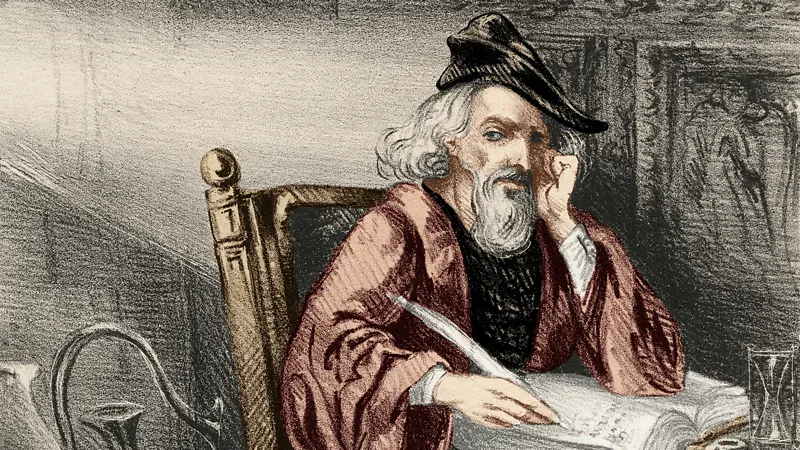
Despite the passage of centuries, the legend of two alchemists who managed to make gold with the philosopher’s stone in the streets of Paris still circulates. It is about Nicolas and Pernelle Flamel, who lived in Paris in the Middle Ages. Recently, Flamel’s will was re-examined, revealing how the reputation of the alchemist emerged.
Many believe that these two figures managed to create the philosopher’s stone. The story, which dates back six hundred years, inspired people such as Isaac Newton, Victor Hugo and J.K. Rowling. The curious point is that Flamel, who lived between 1330 and 1418, had no connection to alchemy.
Alchemy is an Arabic-Greek-origin word and has an ambiguous meaning. For some, the term is associated with Egypt. It is no coincidence that the earliest sources related to alchemy were found in Egypt about 2,000 years ago. Those texts were copied and translated into Europe during the Islamic conquests in the 12th century and took shape under the name “alchemy.” The people who pursued this field—aiming to create gold, cure diseases and bring immortality—were called alchemists (alchemists). Byzantine sources from the 7th century show that the goal of the alchemists was to create a substance known as the “philosopher’s stone.” According to Italian scholar Matteo Martelli, the reference is not to a stone in the literal sense, but to an element in powder form. One factor supporting this hypothesis is a written source dating to the 1st century BC that speaks of a “stone that is not a stone.” As a method of improving nature, the “philosopher’s stone” was intended to turn other metals into gold. In medieval Europe, a belief emerged that it would be beneficial for health and even bring immortality. It is precisely the story of alchemist Nicolas Flamel that finds its place here in the history of alchemy.
In the late 15th century, about 50 to 75 years after Flamel’s death, a book titled “Le Livre Flamel” (Flamel’s Book) was published in France. It was the first of the manuscripts printed using his name. It described the “recipe” for the philosopher’s stone and the transmutation of lead into gold. Martelli notes that some procedures are identical to formulas found in ancient Eastern manuscripts. Thus, an unknown person copied ancient alchemical facts and published them under the name of the deceased Flamel. In those texts, Pernelle is presented as a woman who worked together with Nicolas. At the same time, she is said to possess alchemical knowledge capable of creating the philosopher’s stone.
Many sources described Flamel as a landowner who made donations to churches and charitable organizations. However, newly studied documents show that his investments and influence were greater than previously thought. Of course, the struggle over his inheritance after the death of someone with such an opportunity brought his wealth to the forefront. People suspected the wealthy benefactor who was not an aristocrat. Since in those days engaging in alchemy was regarded as a kind of God’s work, Flamel’s wealth—and the charitable donations—were explained in this way.
The publication of texts under the names of famous people was widespread from the early days of alchemy. In other words, this phenomenon, known as pseudoepigraphy, is a feature of alchemy.
Flamel’s real acts of charity also helped turn him into a myth as an alchemist. For example, the house built by the Flamel family in 1407 and offered as shelter for the poor still stands in Paris today.
At present, Nicolas Flamel’s will is shown to the public for the first time at an exhibition held at the Cluny Museum in Paris.